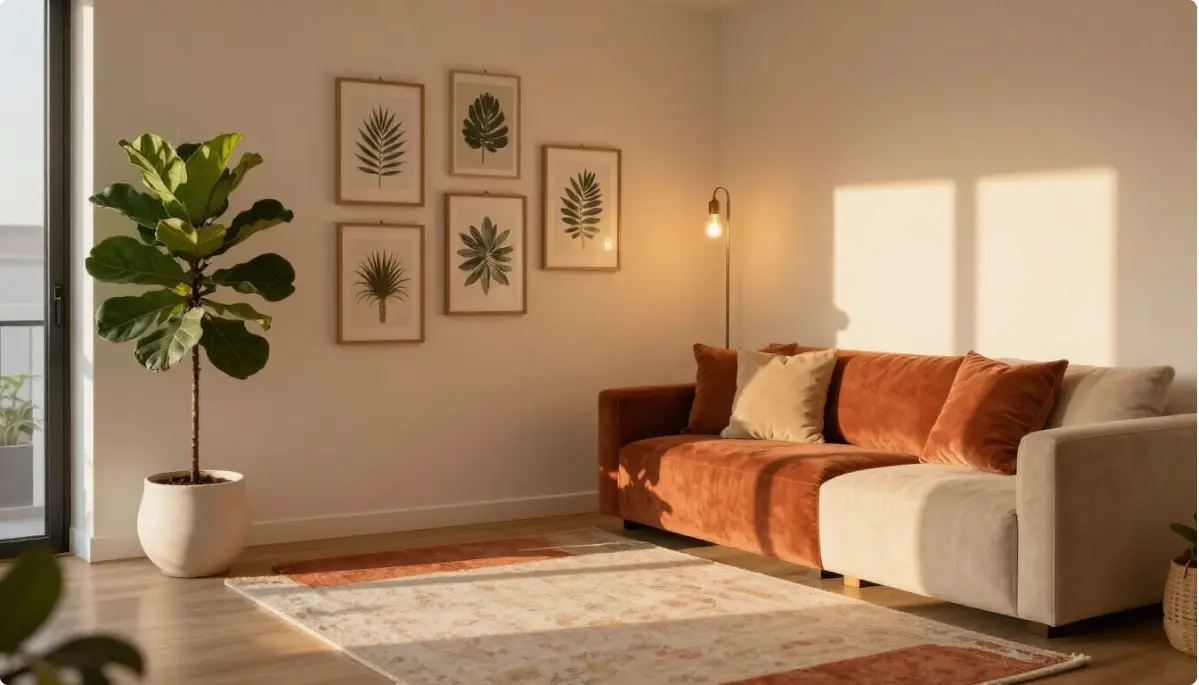
20 Renter-Friendly Decorating Ideas That Won’t Cost You Your Security Deposit

Transform any rental into a styled home with 20 deposit-safe decorating strategies—no nails, no paint, no lease violations required.
By the DecorDreamr Editorial Team · Last updated: April 2026
TL;DR: Renter friendly decorating ideas let you transform any rental into a personal, beautifully styled home without a single nail hole, paint swatch, or lease violation. This guide covers 20 lease compliant ideas across walls, floors, furniture, lighting, and finishing touches, ranked by visual payoff and grouped by room. Every idea is genuinely deposit safe and travels with you when you move.
Introduction
Renter friendly decorating ideas are the difference between a rental that feels temporary and a rental that feels like home. Nearly 44 million American households rent, yet most renters live with white walls, dated fixtures, and flooring they would never have chosen — believing the alternative requires risking their deposit. It doesn’t. The category of damage free decorating has matured dramatically over the past decade, and today’s tools let you transform any rental without a drill, a paint can, or a single nail hole.
This guide covers 20 proven renter friendly decorating ideas across every room — walls, floors, furniture, lighting, kitchens, bathrooms, and finishing touches. Each idea is grouped by impact zone and ranked for the renter who wants the highest visual payoff per dollar invested. If you’re working in a small apartment specifically, pair this with our complete guide on how to decorate a small apartment for layout first strategy.
This guide is built for intermediate decorators — readers who already know what Command strips are but want to go deeper into when, where, and how to use them for genuinely magazine worthy results.
The 5 Highest Leverage Renter Friendly Decorating Moves
- Hang curtains at ceiling height with tension rods — single biggest visual impact for under $100
- Layer two area rugs over existing flooring — covers ugly floors instantly and defines zones
- Install peel and stick wallpaper on one accent wall — transforms a room in an afternoon
- Build a Command strip gallery wall — adds personality without a single nail
- Swap cabinet hardware in the kitchen — 15 minutes per cabinet, looks like a renovation
Key term — “damage free” decor: Any decorating method that leaves zero permanent alteration when removed. Includes Command strips rated for 16+ pounds, peel and stick wallpaper, peel and stick floor tiles, floor tension curtain rods, leaning furniture, plug in sconces, and removable hardware swaps where originals are reinstalled at move out. Every idea in this guide is damage free by definition.
What Are Renter-Friendly Decorating Ideas?

Renter-friendly decorating ideas bridge the gap between a bare rental and a truly personal, welcoming home environment.
Renter friendly decorating ideas are design strategies, products, and techniques that allow tenants to personalize and beautify their living spaces without causing permanent damage or violating standard residential lease terms. These approaches prioritize reversibility — every change can be undone cleanly before move out — while still delivering meaningful, visible aesthetic impact throughout the home.
The concept spans everything from peel and stick wallpaper and damage free adhesive hooks to modular furniture and strategic lighting upgrades. What all renter friendly decorating ideas share is a single unifying principle: your space can be beautiful and genuinely personal without a nail, a drill bit, or any irreversible alteration touching your walls, floors, or fixtures.
Unlike traditional home decorating — which typically involves structural painting, wall drilling, and permanent built ins — renter friendly decorating works within the constraints of a standard lease agreement. According to Nolo’s tenant rights resources, most leases prohibit permanent alterations to walls, floors, and fixtures, but they almost universally permit freestanding furniture, removable adhesives, and portable décor elements. Understanding this distinction is the foundation of every successful renter friendly decorating strategy.
The market for renter friendly products has expanded rapidly. Brands like 3M Command, Tempaper, and NuWallpaper now engineer products specifically for lease compliant use, making it easier than ever to execute renter friendly decorating ideas that look polished and intentional rather than temporary or improvised.
How Is Renter Friendly Decorating Different From Traditional Decorating?
Traditional decorating assumes long term ownership. You paint walls in bold colors, drill into studs for heavy shelving, install custom tile backsplashes, and live with those choices indefinitely. Renter friendly decorating operates on a principle of informed impermanence. You invest in décor that travels with you, products designed to peel away cleanly, and furniture that performs across multiple homes over the years.
This does not mean compromising on style. The best renter friendly decorating ideas are visually indistinguishable from permanent alternatives — until move out day, when they come away cleanly, leaving a pristine canvas for the next tenant.
Why Decorating Your Rental Is Worth the Effort
There is a persistent misconception that decorating a rental is not worth the effort. The “it is just a rental” mindset leads many tenants to spend months or years in spaces that feel sterile and impersonal — which genuinely affects daily quality of life. The American Psychological Association has documented a strong, measurable link between personalized home environments and psychological wellbeing.
When pursued with intention, renter friendly decorating ideas offer a compelling set of advantages permanent decorating cannot match:
- Full deposit protection: Every recommended technique leaves zero permanent damage.
- Portability and residual value: Rugs, lamps, art, and modular furniture travel with you.
- Cost efficiency: No contractor fees, no permanent materials, no landlord imposed repair costs.
- Seasonal flexibility: Refresh your space — swap cushions, change a wallpaper accent, rearrange art — without commitment.
- Lease compliance: Staying within lease terms protects your tenancy, not just your deposit.
- Resale potential: Quality portable pieces retain value and can be resold or repurposed as tastes evolve.
In testing across multiple apartment moves, high quality adhesive strips consistently outperformed cheaper alternatives in both weight capacity and clean removal from painted drywall. The marginal additional cost of quality products is negligible compared to the deposit risk of using unreliable ones.
Want a head start? Try our free First Apartment Move In Checklist — built specifically to walk new renters through every decorating decision in the right order.
Why You Must Read Your Lease Before You Decorate

Thoroughly reviewing your lease is the essential first step before implementing any renter-friendly decorating ideas.
Before applying a single strip of peel-and-stick wallpaper or swapping a cabinet pull, read your lease thoroughly. This step is non-negotiable — and frankly, it is the most underappreciated piece of guidance in any discussion of renter-friendly decorating ideas.
Most standard leases include alteration clauses governing what tenants may and may not modify. These provisions vary significantly by landlord, management company, and state jurisdiction. According to HUD’s tenant assistance resources, tenants are legally bound by the exact terms of their lease, meaning unauthorized changes — even seemingly minor cosmetic ones — can result in deposit deductions, repair billing, or lease termination notices.
Here is exactly what to look for when reviewing your lease through the lens of renter-friendly decorating ideas:
- Alteration clauses: Does the lease define “alteration”? Most definitions exclude removable adhesives, freestanding furniture, and portable light fixtures.
- Painting provisions: Are you prohibited from painting entirely, or are you permitted to paint provided walls are returned to original color at move-out?
- Nail and hole policies: Some leases allow small picture hooks under a quarter-inch diameter; others prohibit all wall penetrations.
- Permission processes: If you want to make a change not clearly covered, how do you formally request approval? Always obtain written confirmation.
- Move-out obligations: Understand precisely what “return to original condition” means in your specific agreement before spending a dollar on decorating.
When uncertain, contact your landlord directly and document every response by email or text. Many individual property owners are significantly more accommodating than corporate management companies, particularly for changes that are clearly reversible and even improve the property’s appearance.
“I’ve always been able to hang nails or paint, but a lot of my followers say they aren’t able to.” — *Tay BeepBoop Nakamoto, Interior Designer and Content Creator, as quoted in [U.S. News Real Estate](https://realestate.usnews.com/real-estate/articles/renter-friendly-decor-ideas-that-wont-forfeit-your-deposit)*
Lease conditions vary dramatically from property to property. Knowing exactly where your specific lease draws the line allows you to pursue renter-friendly decorating ideas with full confidence, without second-guessing every creative decision you make.
How Can You Transform Walls Without Losing Your Deposit?
Walls represent the single greatest opportunity — and the single greatest risk — in any rental. Addressed correctly, they define the entire character of a space. Addressed incorrectly, they become the primary source of deposit deductions.
1. Peel and Stick Wallpaper
Peel and stick wallpaper is one of the most transformative renter friendly decorating ideas available today. Available in hundreds of styles — bold geometric prints, botanical murals, soothing linen textures, realistic exposed brick patterns — quality removable wallpaper can completely change a room’s character in an afternoon.
Brands like Tempaper, NuWallpaper, and RoomMates engineer their products to apply smoothly with minimal bubbling and remove cleanly without paint damage when used correctly. For best results, always test a small section in an inconspicuous spot first, select smooth finish painted walls over textured surfaces, and allow freshly painted walls to cure for at least 28 days before application. Matte and linen finish papers are generally more forgiving during installation than high sheen alternatives.
2. Command Strips and Adhesive Hooks
Command Strips and adhesive hooks from 3M remain the gold standard for damage free wall hanging. The Command range now includes options supporting up to 16 pounds per pair — more than sufficient for framed art, lightweight mirrors, picture ledges, and small floating shelves. Reliable performance depends on following application instructions precisely: clean the surface with isopropyl alcohol, press strips firmly for 30 seconds, allow the adhesive to cure for at least 60 minutes before loading weight, and always remove by pulling the tab straight down slowly rather than at an angle.
3. Removable Wall Decals and Washi Tape
Removable wall decals create large scale pattern and mural effects without the full commitment of wallpaper. Washi tape takes creative possibility even further — because it peels away cleanly in seconds without adhesive residue, it is one of the most flexible of all renter friendly decorating ideas. Use it to create geometric accent wall patterns, faux shiplap horizontal lines, decorative door frame borders, or custom wall art that costs virtually nothing and installs in an hour.
Want to plan your wall layout before you commit? Try our free Damage Free Wall Decor Designer — it maps out exactly what hangs where, sized for your specific wall.
What Are the Best Renter Friendly Flooring Solutions?
Layered area rugs are among the most impactful renter-friendly decorating ideas for instantly transforming rental flooring.
Most renters have essentially no control over their flooring. Whether it is dated linoleum, tired carpet, or scratched hardwood, the floor often makes a rental feel most like a rental. Several effective renter friendly decorating ideas address this directly — none of them require touching the surface beneath.
4. Area Rugs
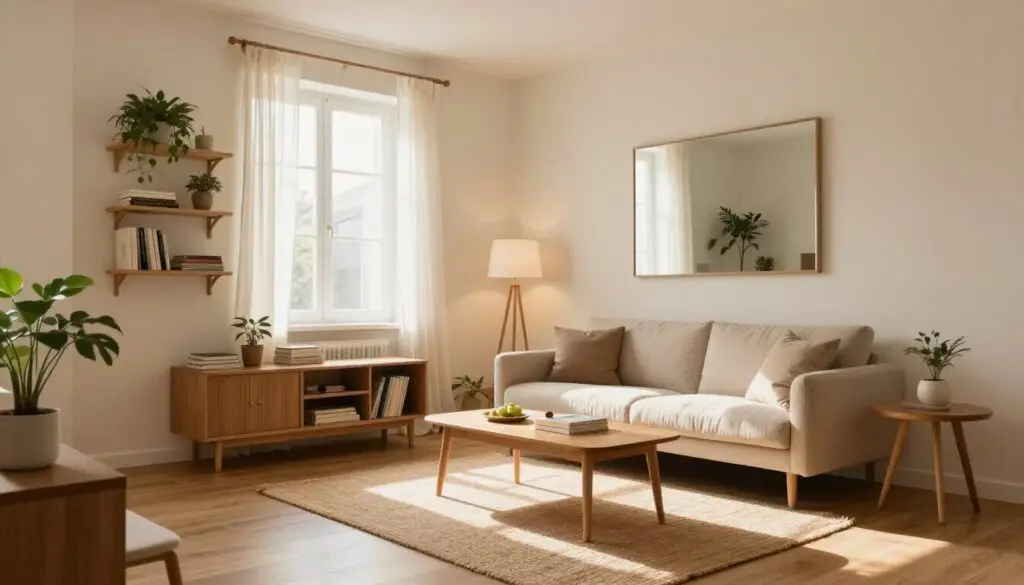
Area rugs are arguably the most versatile single tool in the renter friendly decorating arsenal. They cover worn or unattractive flooring instantly, define zones in open plan spaces, reduce noise transmission significantly, and add warmth, texture, and color — all without touching the surface beneath.
5. Rug Layering
Rug layering is a more advanced technique: placing a smaller, patterned rug on top of a larger, neutral base rug. This creates visual depth and allows for richer creative expression. A large jute or sisal base rug topped with a smaller vintage style or geometric statement piece creates the layered, curated look typically associated with professionally styled interiors. When layering rugs over existing carpet, always use non adhesive rug grippers underneath.
6. Vinyl Peel and Stick Floor Tiles
For renters contending with truly challenging flooring — cracked tile, peeling vinyl, badly stained linoleum — peel and stick vinyl floor tiles offer a genuinely transformative solution. Available in realistic wood grain, stone, marble, and decorative tile patterns, these tiles lay over existing flooring without glue, grout, or professional installation. Critically, they remove cleanly when it is time to move.
Always confirm with your landlord before applying, as some products can interact with older or delicate flooring. Brands like FloorPops and Art3d have thousands of verified reviews confirming clean removal after extended use.
What Furniture Should Renters Actually Buy?
One of the most under appreciated categories of renter friendly decorating ideas has nothing to do with walls or floors. It is about choosing furniture that is portable, versatile, and deliberately designed to work across multiple living situations.
7. Modular Sofas
Modular sofas are the MVP of renter friendly decorating for living rooms. Unlike traditional sectionals locked into a single configuration, modular pieces adapt to any room shape — small studios, awkward L shaped layouts, or wide open floor plans. When you move, they disassemble for easier transport and reconfigure in your new space without requiring new furniture purchases.
8. Multi Functional Furniture
Multi functional furniture extends this principle across the entire home. Consider ottomans with hidden storage doubling as coffee tables, sofa beds eliminating the need for a guest room, nesting tables expanding for entertaining then collapsing for daily use, and storage benches anchoring a bedroom while housing extra linens. These pieces earn their floor space by performing multiple jobs simultaneously.
9. Storage Platform Beds
For renters with limited closet space, a quality storage platform bed provides substantial organizational capacity without adding any additional furniture footprint. Under bed drawers or lift top storage platforms house seasonal clothing, spare bedding, and bulky items that would otherwise compete for closet space.
10. Leaning and Freestanding Storage
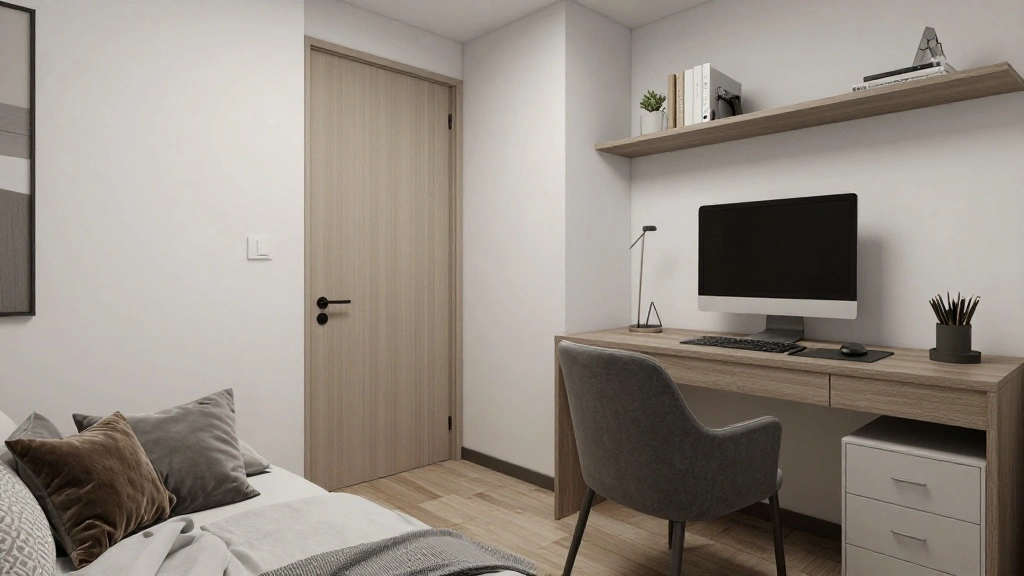
Leaning bookcases, freestanding wardrobes, ladder shelves, and tall narrow cabinets address storage limitations without wall anchors. They look architecturally considered but require no drilling. A tall bookshelf placed strategically can function as a room divider in studio apartments, creating visual separation between sleeping and living zones without constructing anything permanent.
11. Bar Carts
Bar carts are equally underrated: mobile, stylish, and genuinely multipurpose. Use one as a coffee station, a drinks cart, a plant display, a side table, or a rolling kitchen island — and reposition it wherever the layout demands.
How Do Renters Upgrade Lighting Without an Electrician?
layered lighting effect without any visible wiring work. Natural evening light blends with warm artificial lighting for a cozy atmosphere. The scene feels clean, inviting, and practical, with no tools or electrician equipment present. Depth of field, soft shadows, editorial photography style, highly detailed, lifelike textures, no text.” />
Strategic layered lighting is one of the highest-impact renter-friendly decorating ideas that requires zero electrical work or landlord approval.
Lighting is the most underestimated element of interior design — and simultaneously one of the highest impact areas for renter friendly decorating ideas. Most rental apartments arrive with a single overhead fixture per room: flat, harsh ceiling light that flattens everything and makes even well decorated spaces feel institutional.
The constraint for renters: you cannot hardwire new fixtures without a licensed electrician and explicit landlord permission. But you do not need to.
12. Floor and Table Lamps
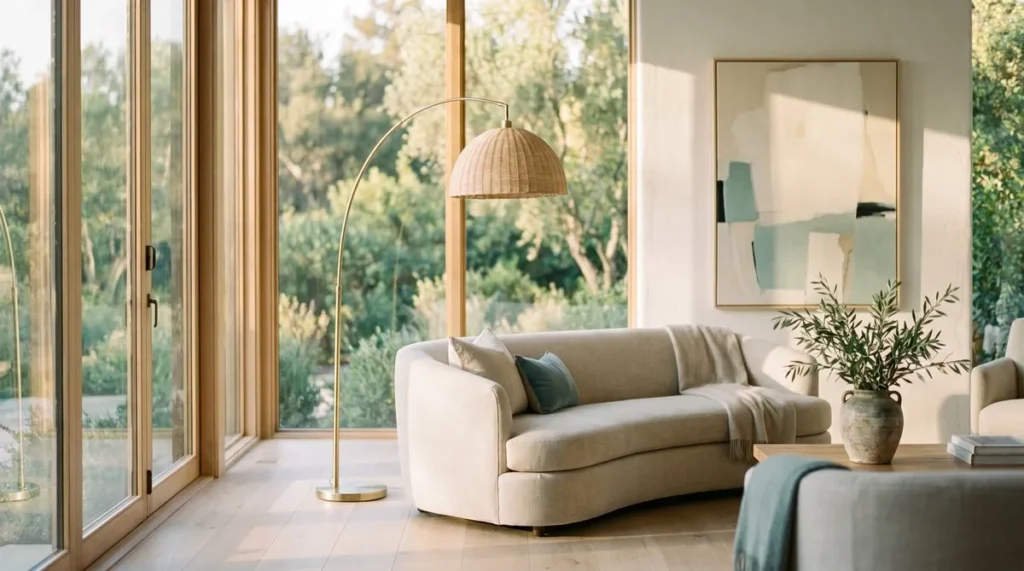
Floor lamps and table lamps are the cornerstone of renter friendly lighting strategy. They create layered light — multiple light sources at different heights — which makes rooms feel warmer and more dimensional. A well placed arc floor lamp beside a sofa, a pair of table lamps flanking a bed, and a small accent lamp on a bookshelf can transform a harsh, single source lit room.
Look for lamps with integrated dimmer switches, or pair standard bases with smart bulbs. ENERGY STAR certified LED bulbs in warm temperatures (2700 to 3000K) are the practical standard.
13. Plug In Wall Sconces
Plug in wall sconces are a revelation. They install with a single adhesive mount or small hook, plug into a standard outlet with a cord hidden via cable management strips, and deliver the kind of warm, ambient wall washing light that most rentals lack. The visual effect is sophisticated and indistinguishable from hardwired alternatives.
14. Battery Operated Puck and Strip Lights
Battery operated puck lights and magnetic mount LED strip lights are powerful for under cabinet kitchen illumination, closet lighting, bookshelf accent light, and inside glass front display cabinets. No wiring, no drilling, no landlord conversation required.
The Easiest Upgrades in Any Rental: Greenery and Textiles
Some of the most effective renter friendly decorating ideas require no tools, no adhesives, and no landlord consultation whatsoever.
15. Indoor Plants
Indoor plants do something no paint or wallpaper can replicate: they bring genuine life into a space. NASA’s landmark Clean Air Study found that common houseplants reduce concentrations of airborne pollutants including formaldehyde and benzene.
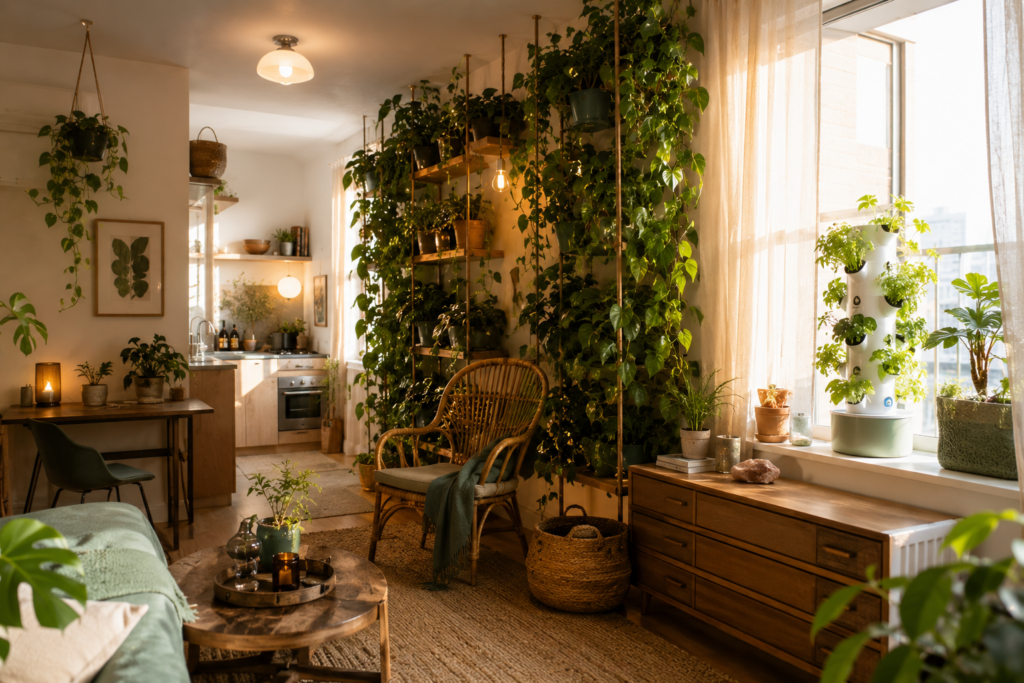
Large statement plants — fiddle leaf figs, monstera deliciosa, bird of paradise, mature olive trees — work as freestanding sculptural elements requiring no wall attachment. Trailing varieties like pothos, heartleaf philodendron, and string of pearls cascade naturally from tall furniture surfaces. Grouped succulents create intentional tabletop vignettes at near zero cost.
“Plants not only add color and texture but also improve air quality, making them a renter friendly way to freshen up your space.” — Extra Space Storage Home Organization Guide
16. Cushions and Throws
Layered cushions on a sofa and a chunky knit throw draped over an armchair add texture, color, and warmth instantly. Mix tactile fabrics — velvet, linen, boucle, cotton knit — rather than competing patterns.
17. Floor to Ceiling Curtains
Curtains deserve dedicated attention. Hanging them higher than the window frame, as close to the ceiling as practical, and wider than the actual window creates the visual illusion of larger, grander windows — a technique professional designers deploy universally. Tension rods make this entirely possible without drilling, and clip on blackout lining panels attach to sheer curtain rings for effective light and privacy control. Total cost is typically under $100. Visual impact is disproportionate.
How Can Renters Upgrade Kitchens and Bathrooms?
Peel-and-stick backsplash tiles transform rental kitchens dramatically and remove without a trace at move-out.
Kitchens and bathrooms arrive with fixed tile, dated fixtures, and the most landlord restricted surfaces of any room. Paradoxically, this is where strategic renter friendly decorating ideas deliver the most dramatic results.
18. Peel and Stick Backsplash Tiles
Peel and stick backsplash tiles are the single most impactful renter friendly kitchen upgrade available. They apply directly over existing tile or smooth wall surfaces, require no grout, and remove cleanly. Available in subway tile, Moroccan zellige, herringbone, hexagonal mosaic, and brushed metallic finishes, these tiles can completely transform a kitchen in two to three hours.
Optimal application requires a clean, smooth, dry surface. Wipe with isopropyl alcohol and allow it to dry fully. Measure and cut tiles with scissors or a utility knife, then apply from bottom to top, pressing each tile firmly. Avoid textured paint or rough grout lines that protrude significantly — these are the primary causes of premature edge lifting.
Backsplash tiles work equally well in bathrooms — applied as a decorative accent above a vanity, around a tub surround, or as a powder room floor feature. Combined with a new shower curtain, coordinated bath mat, and matching towels, this single idea delivers a complete bathroom transformation for under $80.
19. Cabinet Hardware Swaps
Cabinet hardware replacement is one of the most underutilized renter friendly decorating ideas. Swapping builder grade knobs and drawer pulls for brushed brass, matte black, satin nickel, or handmade ceramic alternatives takes 15 minutes per cabinet and typically costs $30 to $80 for an entire kitchen. The only tool required is a screwdriver. Critical: keep all original hardware in a clearly labeled bag and reinstall every piece at move out.
“You can get fun switch cover plates from Etsy, like squiggly or colorful ones. These small changes can make a big difference and are often affordable. Just remember to keep the original hardware to reinstall when you move out.” — Mridu Mody, U.S. News Real Estate
20. Contact Paper
Contact paper extends the hardware swap principle to flat surfaces. Marble effect contact paper applied to laminate countertops is convincingly elegant and peels away cleanly without residue. Applied to the interior back panels of glass front kitchen cabinets, it creates a striking backdrop. Applied as drawer liners, it converts functional spaces into details that feel considered. Costs under $25 and produces results that look significantly more expensive than they are.
Renter Friendly vs. Permanent Decorating: Which Is Right for You?
Not all renter friendly decorating ideas are equally appropriate for every situation. Some tenants hold long term leases with accommodating landlords. Others are on month to month agreements where absolute portability is the priority.
The conclusion for most renters: renter friendly decorating ideas offer a superior risk to reward ratio across virtually every category. The only scenario where permanent changes genuinely make sense is when a landlord provides explicit written permission and you plan to stay five years or more. Even then, reversible solutions remain preferable wherever practical — they protect both parties and preserve flexibility.
Want the full system that walks you through every decorating decision in the right order? The Budget Decor Blueprint is the complete step by step method ($17).
Step by Step: How to Build a Renter Friendly Gallery Wall
A professional gallery wall is achievable in a single afternoon using this six-step renter-friendly decorating process.
A gallery wall is among the most visually striking renter friendly decorating ideas — and it is entirely executable without a single nail hole.
-
Curate your collection deliberately. Gather frames, prints, photographs, and art. Include at least one large anchor piece (18 by 24 inches or larger) alongside medium and small elements. Variation in scale prevents the arrangement from appearing cluttered. A deliberate mix of frame finishes — matte black, natural wood, brushed gold — adds layered visual richness.
-
Arrange everything on the floor first. Lay all pieces on the floor in your intended wall shape. Photograph the layout you find most pleasing. Maintain 2 to 3 inches between pieces for a curated feel, or 4 to 6 inches for a more spacious editorial look.
-
Trace frames onto kraft paper. Trace each frame’s exact outline onto kraft paper or large newspaper. Mark where the hanging hardware sits — this is where the adhesive strip will contact the wall.
-
Tape templates to the wall. Use low tack painter’s tape to affix all paper templates. Step back and evaluate from a normal viewing distance. Adjust freely — rearranging paper costs nothing.
-
Apply Command Picture Hanging Strips precisely. Replace each paper template with the appropriate strips, following 3M instructions exactly. Press for 30 seconds. Allow at least 60 minutes of cure time before applying any frame weight. Rushing this step is the single most common cause of adhesive failure.
-
Hang, level, and style. Hang each frame and check level with a smartphone level app. Add complementary three dimensional elements — a wall mounted shelf with a small plant, a round mirror, a typographic print — to vary the surface texture and prevent the arrangement from reading as flat.
Total investment with quality strips and thrifted frames: under $100. Installation time: 3 to 4 hours. Removal at move out: under 45 minutes, no trace.
What Are the Most Common Renter Decorating Mistakes?
Even the best renter friendly decorating ideas can go wrong in predictable ways:
- Using cheap adhesive products. Low quality hooks frequently fail or leave residue. Invest in 3M Command — the cost difference is negligible relative to deposit risk.
- Skipping surface preparation. Adhesive performance depends entirely on cleanliness and dryness. Always wipe with isopropyl alcohol first.
- Applying peel and stick wallpaper to incompatible surfaces. Textured paint, rough plaster, and fresh paint under 28 days all cause adhesion failure. Always test first.
- Ignoring vertical space. Failing to use space above eye level is one of the most consistent oversights. Ceiling height curtains and tall freestanding bookshelves draw the eye upward and make rooms feel larger.
- Over scaling furniture. Large sectionals and oversized dining tables overwhelm smaller rentals. Always measure and tape footprints on the floor before purchasing.
- Discarding original hardware. When swapping cabinet pulls or switch covers, store originals in a sealed, labeled bag. Failing to reinstall at move out is a preventable source of deposit deductions.
- Assuming damage free needs no notification. A friendly heads up email to your landlord prevents misunderstandings at final inspection and builds goodwill.
- Under investing because it feels temporary. Quality renter friendly pieces follow you to every future home. A great rug, lamp, or art piece earns its cost across multiple rentals.
Frequently Asked Questions
Understanding renter decorating patterns and common deposit concerns helps inform smarter, more strategic decorating decisions.
What exactly are renter friendly decorating ideas and how do they differ from regular home decorating?
Renter friendly decorating ideas are design strategies and product based techniques that allow tenants to meaningfully personalize their living spaces without causing permanent damage or violating standard lease terms. Unlike traditional home decorating — which involves permanent painting, drilling, tiling, or structural modifications — renter friendly approaches prioritize complete reversibility. Every change is designed to be undone cleanly at move out, protecting the tenant’s security deposit while achieving significant visual impact through products like peel and stick wallpaper, adhesive strips, portable furniture, removable tiles, and strategic plug in lighting.
How can I decorate my rental apartment without losing my security deposit?
To protect your deposit while pursuing renter friendly decorating ideas, always use adhesive products rated for your specific wall surface and follow manufacturer instructions precisely, avoid all drilling or nailing without explicit written landlord approval, retain and store all original hardware in labeled bags for reinstallation, and photograph the space before and after every change. Focus exclusively on portable and damage free solutions: area rugs, removable wallpaper, Command strips, freestanding furniture, plug in lighting, and peel and stick tiles. Reading your lease before any decorating change is the most important preparatory step.
Are peel and stick wallpaper and removable wall products truly damage free?
Quality peel and stick wallpaper from reputable manufacturers — Tempaper, NuWallpaper, RoomMates — is engineered to remove cleanly without damaging paint or drywall when applied and removed according to instructions. However, results depend on wall condition. Freshly painted walls under 28 days old, heavily textured surfaces, and walls with peeling paint may show minor lift during removal. Always test in a small low visibility area first, follow guidelines precisely, and consider informing your landlord before installing on prominent feature walls.
How much does it typically cost to implement renter friendly decorating ideas on a realistic budget?
Renter friendly decorating can range from essentially free — rearranging existing furniture, adding propagated houseplants, repurposing thrifted frames — to several thousand dollars for a comprehensive refresh. Most individual high impact upgrades are surprisingly accessible: a roll of peel and stick wallpaper runs $30 to $80, a quality area rug $50 to $300, a pack of Command Picture Hanging Strips $8 to $20, a full kitchen hardware swap $30 to $80. Many renters achieve dramatic results for under $500 per room when prioritizing high impact ideas strategically.
What are the most common mistakes renters make when decorating?
The most consistently documented mistakes include using cheap adhesive products that fail or leave residue, skipping surface preparation before adhesive application, applying peel and stick wallpaper to incompatible textured surfaces without testing, and failing to store original hardware for reinstallation. Many renters also under invest in their environment because it feels temporary — but since most quality renter friendly decorating ideas involve fully portable pieces, every dollar invested travels with you to future homes.
Can I paint my rental apartment without asking my landlord?
Painting without explicit landlord permission is among the most common and costliest mistakes renters make. Most standard leases prohibit painting without prior written approval, and unauthorized painting typically results in deposit deductions of $300 to $800 per room. The correct approach is asking your landlord in writing via email. Many landlords — particularly individual property owners — approve painting to a specific neutral color, especially when tenants commit in writing to returning walls to original color before move out. If denied, peel and stick wallpaper and newer removable paint products are excellent alternatives.
What’s the highest impact renter friendly decorating idea I can do this weekend?
Hanging floor to ceiling curtains on a tension rod, mounted higher than the window frame and wider than the window itself. Total cost is typically under $100, installation takes about an hour, and the visual impact rivals expensive room wide changes. It makes ceilings appear taller, windows appear grander, and the entire room feel intentionally designed. No drilling required.
Do peel and stick floor tiles damage existing flooring underneath?
Quality peel and stick floor tiles from reputable brands — FloorPops, Art3d — are engineered to remove cleanly from most modern flooring. However, application to old, peeling, or delicate flooring can cause damage. Always test in a closet or under furniture first, confirm with your landlord, and avoid applying to flooring that already shows signs of wear or peeling.
What’s the difference between Command strips and regular adhesive hooks?
Command strips use a proprietary stretch release adhesive that removes cleanly when pulled straight down by the tab. Regular adhesive hooks — including most generic alternatives — typically use permanent or semi permanent adhesive that pulls paint and drywall on removal. The price difference is usually less than $5; the deposit difference can be $50 to $300 or more. There is no scenario where saving on adhesive quality is the right call in a rental.
How do I make my rental feel more luxurious without spending a lot?
Three high leverage moves: swap any harsh overhead bulbs for warm 2700 to 3000K alternatives and add one quality floor lamp; invest in two or three quality textiles — a real linen duvet, a jute rug, a velvet cushion — rather than many cheap ones; edit every surface ruthlessly, keeping only what is genuinely meaningful. Restraint, sensory quality, and curation create the feeling of luxury, not quantity or expense.
Conclusion
Renter friendly decorating ideas have never been more sophisticated, affordable, or visually powerful than they are today. The strategies in this guide — from damage free wall transformations and smart flooring solutions to modular furniture, layered lighting, and targeted kitchen upgrades — collectively prove that renting does not mean living in a generic, provisional, or impersonal home.
Three takeaways: First, always begin with your lease. Knowing precisely what is permitted lets you act boldly within those boundaries. Second, invest in quality materials — especially adhesive products and removable wallpaper. The difference between a budget brand hook and a quality Command strip is the difference between a clean wall and a deposit dispute. Third, think portably across every purchase. The best renter friendly decorating ideas involve pieces that move with you, meaning every dollar invested in your current rental keeps serving you in every home afterward.
Your home — rented or owned — is where you begin and end every day. It deserves to feel genuinely yours.
The most effective next step you can take today: choose one room, select one idea from this guide, and execute it this weekend. Whether it is a statement rug, a roll of peel and stick wallpaper, or a Command strip gallery wall — start somewhere specific. The transformation of a rental into a home you genuinely love begins with one well chosen, confidently executed decision.
 A thoughtfully decorated rental proves that renter-friendly decorating ideas create a home that feels deeply personal, not temporary.